
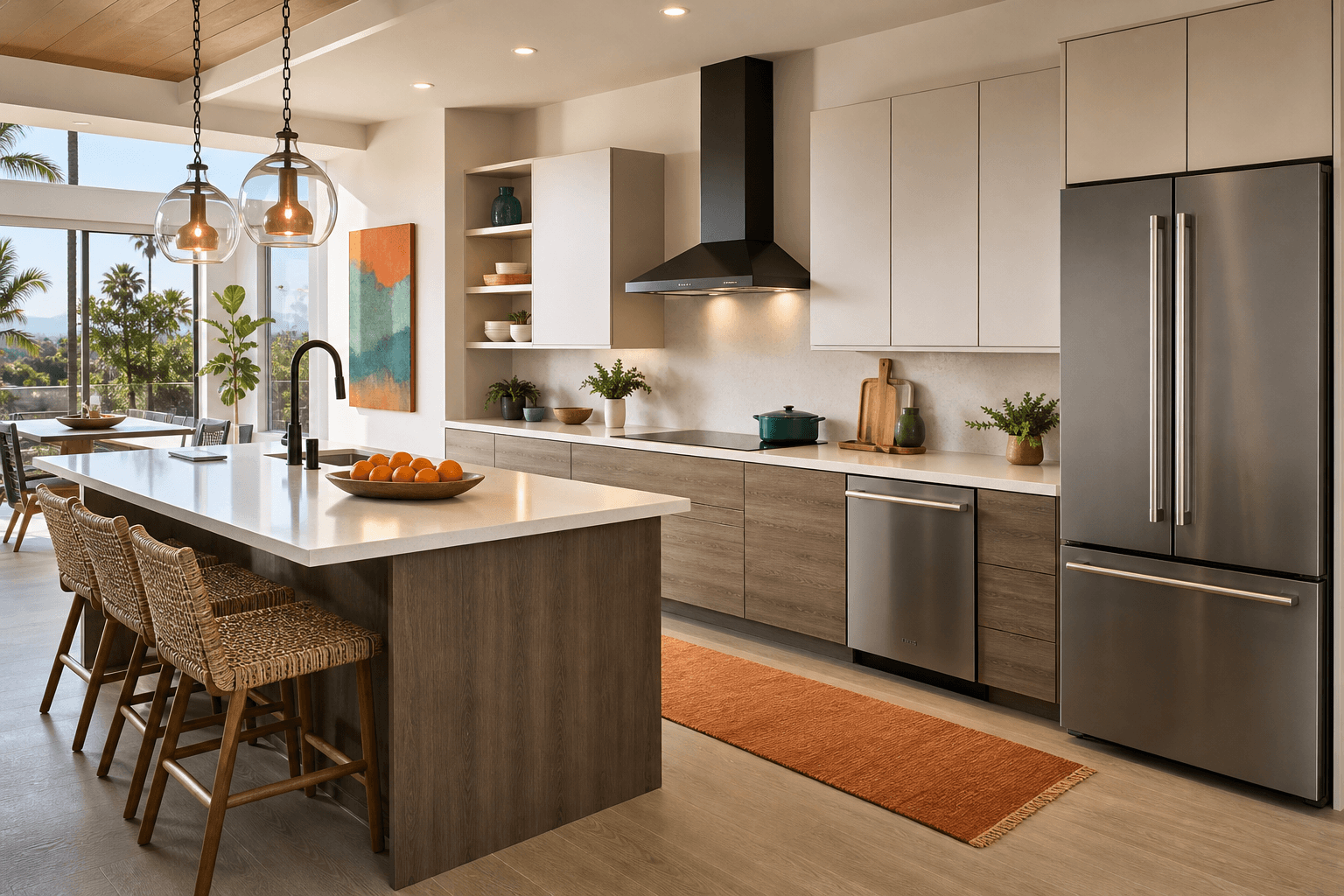
Energy-efficient appliances are not chosen by the label alone. Compare a model’s verified energy or water use with similar products, then confirm its capacity, dimensions, door clearances, electrical service, plumbing, ventilation, and cabinet integration before ordering. In a kitchen remodel, resolve appliance choices early because they affect the layout, rough-ins, cabinetry, and sometimes permit planning.
The best choice is the appliance that uses resources responsibly, suits how you cook, fits the room without awkward compromises, and does not create avoidable installation or service problems.
What Energy Efficiency Means When You Are Remodeling
For a kitchen appliance, energy efficiency means delivering its intended function while using less electricity, gas, or water than comparable equipment. Compare verified consumption, capacity, operating settings, purchase price, expected use, and installation requirements.
ENERGY STAR certification indicates that a product meets performance criteria established for its category. It is a qualification mark, not a promise that every certified appliance will cost less to operate in every household.
The EnergyGuide label helps you compare estimated energy use and operating cost among similar appliances. The Federal Trade Commission explains that the label is designed for comparison and that a higher purchase price may be offset by lower utility costs over time, depending on the model and how it is used. Read the estimated annual use alongside capacity and features. The FTC’s EnergyGuide explanation shows how to use the label while shopping.
For cooking equipment, ENERGY STAR states that certified electric cooking products are 18% more efficient on average than standard models in the referenced category. That figure does not describe every appliance, cooking method, or household. ENERGY STAR’s electric cooking guidance also explains how induction transfers heat directly into compatible cookware.
Examples of Energy-Efficient Kitchen Appliances

There is no single best appliance package for every kitchen. The table below connects each category to the decision that matters during a remodel.
| Appliance | Efficiency information | Remodel fit | Best decision focus |
|---|---|---|---|
| Refrigerator | EnergyGuide estimate, capacity, configuration, and temperature settings | Opening, depth, door swing, ventilation, water line, and delivery path | Choose the smallest practical capacity for your household. |
| Dishwasher | Annual energy use, water use per cycle, and cycle options | Opening, adjacent cabinets, drain, water supply, and electrical connection | Match capacity and cycles to full-load frequency. |
| Range or oven | Available efficiency information, cooking method, and expected use | Opening, fuel connection, circuit, landing space, and ventilation | Choose around cooking habits and available utilities. |
| Cooktop | Cooking method, power rating, controls, and cookware compatibility | Cutout, circuit capacity, counter depth, and hood position | Induction offers responsive electric cooking but needs compatible cookware and electrical planning. |
| Ventilation hood | Airflow, control settings, lighting, and operating efficiency | Width, duct route, exterior termination, and cabinet design | Prioritize effective capture and a workable duct plan. |
Refrigerators: capacity and depth are efficiency decisions too
A counter-depth refrigerator can improve circulation but usually offers less storage than a standard-depth model of similar width. A standard-depth refrigerator may suit a larger household, yet its deeper body and door swing need more clearance around islands, walls, and cabinets.
Record household size, shopping frequency, storage needs, and the configuration that fits the room. French-door, side-by-side, top-freezer, and bottom-freezer layouts change reach, shelf width, freezer access, and swing clearance. Do not pay for capacity you will rarely use.
Dishwashers: compare water use with your real routine
An efficient dishwasher is useful only if its capacity and cycles match your household. If you routinely run partial loads, a suitable shorter or smaller-load setting may matter more than specialty features. If you wait for full loads, compare the water and energy information for the normal cycle you will use.
Installation also depends on the sink cabinet, drain route, water supply, floor height, and adjacent doors. A model can fit the nominal opening yet interfere with a corner cabinet, island seating, or nearby drawer.
Induction, gas, and conventional electric cooking
Induction cooktops and ranges use electromagnetic energy to heat compatible cookware directly. They can provide fast temperature response and a smooth surface, but they require compatible cookware and an electrical supply sized for the equipment. Discuss the circuit, panel capacity, wiring route, and counter cutout before cabinets are ordered.
Gas cooking may suit a household that values a familiar flame and existing infrastructure, but it still needs correctly planned ventilation and utility connections. Conventional electric radiant cooking may simplify some installations, while its response and surface behavior differ from induction. Choose based on how you cook, what the home can support, and the complete installation scope.
Ovens and hoods
For an oven, compare usable cavity size, cooking modes, preheat behavior, controls, and the information supplied for the exact model. A large cavity helps with batch cooking but occupies more space and may require a different cabinet arrangement.
A hood is part of the appliance system, not a decorative afterthought. Confirm width, mounting height, duct size, route, exterior termination, controls, and its relationship to the cooktop. A recirculating hood does not perform the same function as a properly ducted system.
Compare the Total Value, Not Just the Sticker Price
A higher-priced efficient appliance is not automatically the better purchase. Compare purchase price, verified annual energy or water information, expected frequency of use, installation requirements, and serviceability over the time you expect to keep it.
- Define the actual job. Record household size, frequency of use, required capacity, and cooking performance.
- Compare similar models. Review EnergyGuide information, ENERGY STAR status where applicable, dimensions, cycles, and capacity.
- Price the installation. Include cabinetry, electrical work, plumbing, gas work, ventilation, trim, delivery, and removal.
- Check useful features. Extra settings have value only when they solve a real household need.
- Consider service access. Integrated equipment still needs room for maintenance and replacement.
Hypothetical example: Suppose Model A costs $1,800 and Model B costs $2,300. Model B has lower estimated annual energy use but requires a new circuit and cabinet modification. Model A fits the existing opening with minor work. The correct comparison includes the $500 difference, installation cost, frequency of use, capacity, verified operating information, and expected ownership period. No fixed payback period can be calculated without those details.
California Requirements to Consider Before Ordering
California’s appliance rules and building-energy requirements are related but not interchangeable. Title 20 appliance regulations establish minimum energy and water performance requirements and compliance information for covered products sold or offered for sale in the state. Review California’s Title 20 appliance regulations for the current framework.
Regulated appliances have testing, marking, certification, and performance requirements. An appliance described as “high efficiency” is not automatically compliant. Verify the exact model and category through applicable California information before purchase.
The 2025 Energy Code took effect January 1, 2026. It includes electric-ready requirements that may affect substantial remodeling or new construction planning, but applicability depends on the building, project scope, and proposed systems. California’s current Energy Code update provides broader context.
Use these rules as a reason to verify details early, not as a project-specific permit conclusion. Your remodel team should identify which requirements apply to the property, appliance category, fuel choice, and scope before ordering equipment.
Coordinate the Appliance With the Kitchen Before Design Is Final

Appliances should be selected before cabinet drawings and rough-ins are finalized. A few inches can affect filler panels, door swings, countertop overhangs, landing areas, island circulation, and whether a refrigerator door opens far enough to remove its bins.
Record the physical fit
- Required opening width, height, depth, floor height, and transitions.
- Door and drawer swing, handle projection, wall clearance, and adjacent cabinet interference.
- Counter-depth or standard-depth dimensions, including hinges and doors.
- Ventilation space, service clearance, and delivery dimensions.
Resolve utilities and rough-ins
- Voltage, amperage, circuit type, receptacle location, and panel capacity.
- Gas line location, shutoff access, and connection details.
- Water supply and drain routing for refrigerators and dishwashers.
- Hood duct size, route, exterior termination, and cabinet conflicts.
- Lighting, controls, and outlet locations that remain accessible.
These decisions are part of the remodeling scope, not just a shopping exercise. JR07 Development’s kitchen remodeling work includes layout redesign, cabinetry, lighting and electrical upgrades, plumbing, fixture installation, and modern appliance integration. Readers planning the full room can review kitchen remodeling as they decide which design and installation responsibilities need coordination.
Which Upgrades Should You Prioritize on a Limited Budget?
Start with appliances and conditions that control the room. A model requiring a new circuit, cabinet change, or duct route should be resolved before cosmetic selections.
- If an appliance is failing or unsafe, replace it with a suitable, verified model instead of waiting for a complete suite.
- If the refrigerator controls the aisle or cabinet layout, choose its configuration and depth first.
- If the dishwasher is relocated, resolve water, drain, electrical, floor, and cabinet conditions.
- If you cook daily, prioritize the cooking method and ventilation system that fit your habits and utilities.
- If electrical service cannot support induction, price the electrical work before choosing equipment.
- If an existing appliance works and fits well, consider keeping it while funding a higher-priority upgrade.
- If the budget is tight, defer appearance-only features that do not improve efficiency, capacity, accessibility, or fit.
Replace a complete suite when appliances are similar in age, locations are changing, or mismatched depths and finishes would compromise the design. Replace one appliance when the others are reliable, correctly sized, and compatible with the new kitchen.
Features and Buying Decisions That Commonly Go Wrong
The appliances to avoid are not a universal list of brands. They are poor matches for your room, routine, utilities, or service needs.
- Buying by appearance before measuring: A showroom finish cannot compensate for blocked circulation or a dishwasher door that hits an island.
- Assuming standard dimensions: Nominal widths exclude doors, handles, hinges, fillers, leveling legs, and clearances.
- Choosing excess capacity: Oversized equipment can cost more and consume valuable space without improving use.
- Selecting induction without electrical planning: Confirm cookware compatibility and circuit requirements first.
- Relying on vague efficiency language: Ask for the exact model’s label, certification status, annual use information, and installation requirements.
- Ignoring hood performance: A recirculating solution may not meet a kitchen’s functional ventilation needs.
- Choosing complexity without service access: Specialty features are poor value if unused or difficult to maintain.
- Ordering before coordination: A delayed appliance can hold up cabinets, counters, trim, rough-ins, and final installation.
Use the Kitchen More Efficiently After Installation
Run dishwashers with appropriately full loads, select suitable efficient cycles, keep refrigerator seals clean and intact, and clean filters according to appliance instructions. Avoid repeated preheating or extra cycles when they are unnecessary for the task.
Kitchen design affects use. Place cookware near the cooking zone, organize refrigerator items to reduce repeated door openings, and use task lighting so you do not over-light the entire room. Reduce standby loads where practical without unplugging equipment that needs continuous operation or safe controls.
There is no universal answer to what runs up an electric bill the most. The largest contributor varies with appliance type, household behavior, climate, utility rates, equipment condition, and operating frequency. Use appliance labels and utility data to identify actual priorities.
Energy-Efficient Appliance Pre-Purchase Worksheet
Complete this worksheet for every appliance before ordering. Keep installation instructions with the design documents so cabinet, electrical, plumbing, and ventilation decisions use the same information.
| Item | Question to answer |
|---|---|
| Exact model | What is the complete model number? |
| Efficiency | What annual energy or water information is shown, and is ENERGY STAR certification applicable? |
| California status | Does the category require California certification or other compliance information? |
| Dimensions | What are the product, opening, finished-depth, and clearance dimensions? |
| Opening | Will doors and drawers clear walls, islands, and adjacent cabinets? |
| Capacity | Does the size match household use without sacrificing circulation? |
| Electrical | What voltage, amperage, circuit, receptacle, and panel conditions apply? |
| Fuel | Does it require gas, electric, or a specific connection method? |
| Water and drain | Are supply, filtration, drain, shutoff, and leak access coordinated? |
| Ventilation | What hood, duct, clearance, termination, or make-up air conditions apply? |
| Cabinet integration | Are fillers, panels, trim, supports, and service openings documented? |
| Delivery | Can the packaged appliance reach the room through every passage? |
| Service | Can it be removed or repaired without damaging finished work? |
| Responsibility | Who confirms, orders, receives, installs, and handles damage or missing parts? |
Questions Homeowners Ask Before Choosing
Which kitchen appliances should I replace first if my remodeling budget is limited?
Replace the appliance that is failing, controls the layout, or requires the most extensive utility work. If others remain reliable, coordinate their fit first and replace only where efficiency, capacity, or daily use will meaningfully improve.
Are induction appliances always more efficient than gas or conventional electric models?
No. The comparison depends on the equipment, cooking habits, cookware, utilities, and ventilation plan. Induction is a strong option to evaluate, not a universal answer.
What should I check before buying an ENERGY STAR-certified appliance for a California kitchen?
Check certification status, EnergyGuide or equivalent operating information, capacity, dimensions, installation requirements, and applicable California compliance information. Certification does not replace a fit check or project-specific utility review.
Which appliance features can create poor value or installation problems?
Oversized capacity, unneeded controls, concealed service access, unusual dimensions, incompatible cookware requirements, and unplanned ventilation or electrical demands can all create poor value.
Do energy-efficient appliances affect kitchen remodeling permits or electrical planning?
They can. New equipment may change circuits, panel loads, gas connections, ventilation, cabinetry, or electric-ready planning. Requirements vary by appliance, property, building type, and project scope.
A Remodel Decision You Can Take to Your Contractor
Choose appliances around how you cook, verify efficiency information, and coordinate physical requirements before ordering. JR07 Development’s portfolio includes a modern 60-unit development described as using energy-efficient systems, illustrating how resource-conscious planning can extend beyond a single kitchen. View examples of energy-efficient systems in larger development work.
If you are planning a coordinated remodel in Southern California, bring your appliance worksheet to JR07 Development so the layout, cabinetry, electrical work, plumbing, ventilation, and appliance integration can be considered together through its kitchen remodeling service.