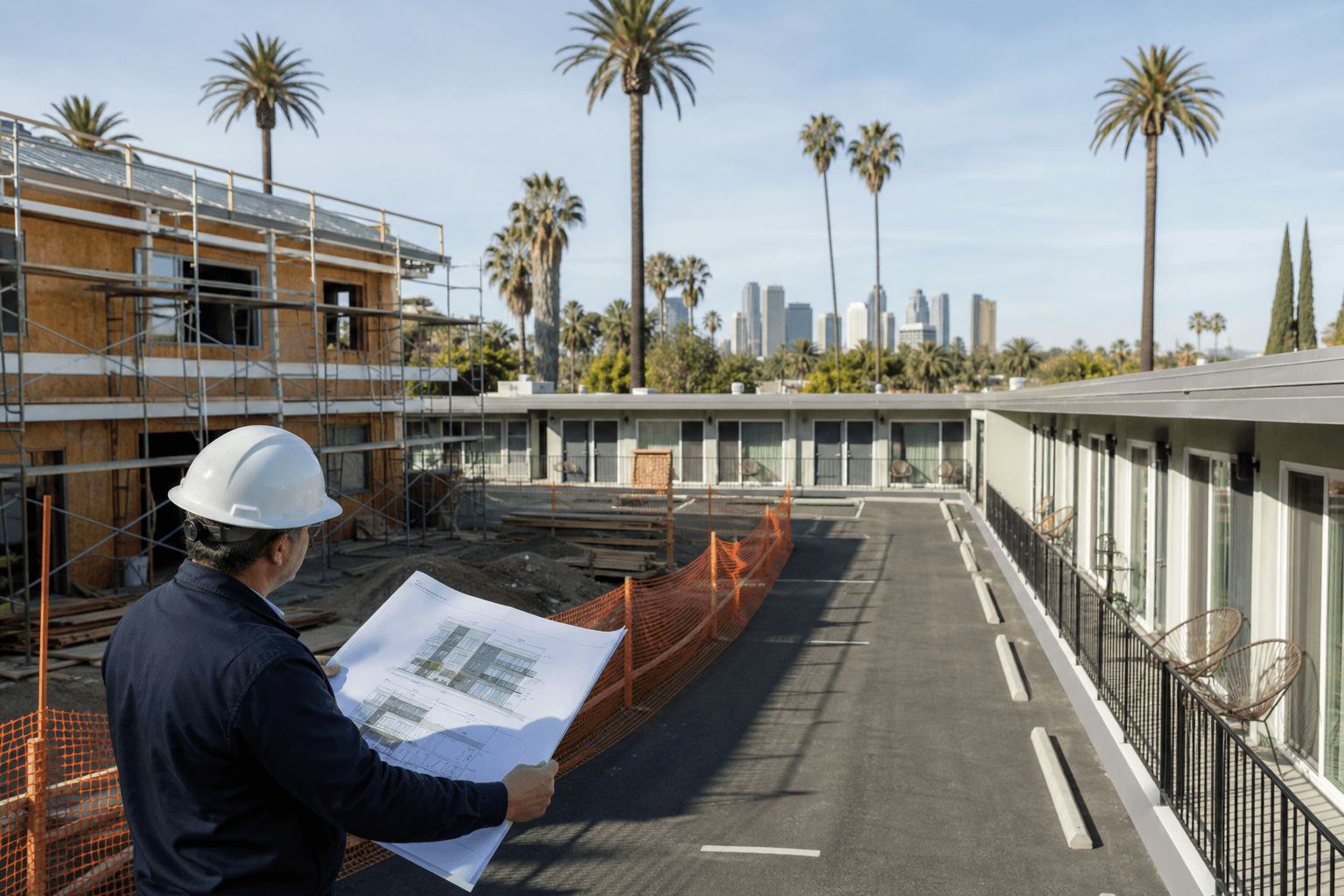
The right Los Angeles motel project starts with evidence, not finish selections. Limited damage may call for restoration or renovation, while serious structural problems, a changed use, or extensive code work may point to rebuilding or conversion.
Begin by documenting the property, confirming its intended use, and identifying approvals that may apply. Then separate safety and compliance work from guest-facing improvements so you can make a defensible decision about scope, cost, phasing, and disruption.
Quick summary

- Use restoration for targeted damage, renovation for modernization, rebuilding for substantial structural loss, and conversion when the property’s intended use changes.
- Review structure, utilities, fire and life safety, accessibility, and property use before approving finishes.
- Address Los Angeles building codes, permits, inspections, and local processes during preconstruction.
- Decide early whether the motel will close, operate partially, or be renovated in phases.
- Compare contractors by hospitality experience, scope clarity, insurance, project management, pricing transparency, and relevant references.
Choose the right project path before defining the scope
“Motel restoration strategies” can describe several different types of work. Restoration may return a damaged property to safe, usable condition. Renovation may modernize an outdated motel while preserving its basic use and structure. Rebuilding may replace major portions after extensive damage or structural failure. Conversion may change the property into another form of housing or use.
These categories overlap, but they should not be treated as interchangeable. A budget based only on visible finishes can fail when inspections reveal structural repairs, obsolete utilities, water damage, or life-safety issues. A conversion also requires early review of use, approvals, accessibility, and building requirements.
California public programs show that hotels and motels can be involved in housing conversion and rehabilitation projects. Such projects may involve health, safety, building-code, and accessibility considerations. Review the California Department of Housing and Community Development’s Homekey information for context, then verify requirements for the specific property.
Restoration, renovation, rebuild, or conversion: which fits?

The framework below supports initial owner discussions. It is not a substitute for site investigation, design review, code analysis, or authority confirmation.
| Project path | When it may fit | Questions to resolve | Operational effect |
|---|---|---|---|
| Restoration | Damage is concentrated and the use remains unchanged. | What must be demolished, repaired, dried, replaced, tested, or inspected? | May be phased depending on affected rooms, utilities, and safety conditions. |
| Renovation | The motel remains viable but needs modernization or repositioning. | Which rooms, lobbies, exteriors, utilities, and finishes need upgrading? | Often compatible with planned phases, subject to noise and utility controls. |
| Structural rebuild | Major portions cannot be safely retained. | What can remain, and what must be redesigned or rebuilt? | May require substantial closure or isolated work zones. |
| Conversion | The intended use changes, such as adaptive reuse for housing. | What occupancy, accessibility, safety, planning, and building rules apply? | Usually requires more planning before construction. |
Do not decide from photographs alone. Request an existing-condition review that identifies visible and concealed risks, areas needing further investigation, and the difference between confirmed work and allowances.
Build the scope around safety, compliance, and guest experience
Prioritize work in layers. First address the property’s ability to operate safely. Next review compliance and functionality. Only then prioritize guest experience and visual positioning. Finishes should not obscure problems in structure, water intrusion, utilities, access, or life-safety systems.
Document structural and site conditions
Review foundations, framing, roofs, balconies, stairs, exterior walls, drainage, water intrusion, damaged surfaces, and site conditions affecting demolition or reconstruction. A contractor should explain when testing, engineering, design professionals, or authority review may be necessary.
Review systems and safety requirements
Map electrical, plumbing, mechanical, fire protection, security, and other building systems. Exact requirements depend on the property, scope, jurisdiction, and intended use. Do not assume a room refresh can proceed independently of shared systems.
Los Angeles rehabilitation guidance identifies health, safety, building-code, and disaster-related improvements as relevant considerations, including work that may require permits. Review the Los Angeles Housing Department’s rehabilitation work guidance, then confirm requirements for the property.
Separate mandatory work from guest-facing upgrades
List guest rooms, bathrooms, corridors, lobbies, offices, amenities, parking, signage, facades, and landscaping separately. Label each item as required repair, operational improvement, market upgrade, or optional finish.
JR07 Development’s supplied portfolio describes motel and hotel work involving guest rooms, lobbies, exteriors, structural repairs, and modernization. Reviewing completed motel renovations can help owners compare how room and lobby upgrades fit within broader property work.
Treat Los Angeles approvals as an early checkpoint
Permitting and inspection questions should be addressed while the scope is being formed. Requirements may change based on location, existing approvals, proposed work, damage, occupancy, and intended use. A renovation is not automatically subject to the same process as a structural rebuild or conversion.
Ask who will identify applicable authorities, coordinate documents, track reviews, and schedule inspections. Confirm what the contractor includes and what remains the owner’s responsibility, particularly for changed use, structural modifications, disaster damage, accessibility work, or shared systems.
Before finalizing the plan, account for Los Angeles building codes and local permitting processes that may affect approvals, costs, inspections, and sequencing. General local experience does not replace project-specific confirmation.
Plan construction around occupancy and disruption
Decide whether the property will close, remain partially operational, or be renovated in phases. The choice depends on affected rooms, access, utilities, noise, dust, safety separation, inspections, procurement, and operating requirements.
If partial operation is possible, document guest and worker separation, available entrances and corridors, deliveries, waste, emergency access, and housekeeping. Identify work that could interrupt water, power, heating, cooling, internet, security, or fire systems.
Sequence demolition and repairs before finishes, while coordinating long-lead items with inspections and room closures. Include contingencies for concealed damage, delayed approvals, unavailable materials, and demolition discoveries. Fast-track delivery may help coordinate hospitality work, but it does not remove the need for design decisions, permits, inspections, procurement, or safe controls.
Operational details such as access, noise, amenities, and service continuity deserve the same attention as room finishes. For one example of how a specific amenity can affect operating decisions, owners can evaluate on-site guest laundry before booking extended-stay accommodation.
How to evaluate a motel restoration contractor
- Relevant experience: Request examples involving rooms, lobbies, exteriors, structural repairs, or modernization.
- License and insurance: Confirm licensing, bonding, insurance, and coverage for the proposed work.
- Scope documentation: Require assumptions, allowances, exclusions, alternates, and a clear description of what is not included.
- Project management: Identify who handles communication, trades, schedule updates, decisions, and escalation.
- Pricing transparency: Ask how concealed conditions, change orders, and owner selections are documented.
- Operational planning: Request controls for occupied areas, access, deliveries, noise, dust, utilities, and inspections.
- References: Speak with relevant owners about communication, workmanship, disruption, and issue resolution.
JR07 Development states that it is licensed, bonded, and insured, has more than 25 years of experience and over 500 completed projects, and assigns a dedicated project manager to every project. Its stated service area includes Los Angeles, Orange, San Diego, and Riverside counties. Owners should still request references and a proposal matching the specific motel scope.
Questions to ask before approving the plan
- What findings support the proposed restoration, renovation, rebuild, or conversion classification?
- Which work is confirmed, which is an allowance, and which depends on testing, design, demolition, or review?
- What structural, fire and life-safety, accessibility, utility, and health issues must be resolved first?
- Which permits, inspections, approvals, and agency discussions are expected, and who coordinates them?
- Can the property remain partially operational, and which rooms, utilities, access routes, or services are affected?
- What is the sequence for demolition, repairs, systems, rooms, common areas, exterior work, inspections, and closeout?
- Which materials have procurement dependencies, and what alternatives are acceptable?
- How are concealed damage, changes, exclusions, and schedule impacts documented?
- Who is the project manager, how often are updates provided, and who approves changes?
- What warranties, inspection records, operating information, and closeout documents will be delivered?
A preconstruction checklist for Los Angeles motel projects
- Document structure, systems, rooms, common areas, exteriors, and damage.
- Confirm intended use before choosing a project path.
- Separate safety and compliance work from functional improvements and optional finishes.
- Identify responsible authorities and confirm the project-specific review path.
- Choose closure, partial operation, or phasing after mapping access, utilities, noise, safety, and inspections.
- Obtain comparable proposals using the same drawings, assumptions, allowances, exclusions, and alternates.
- Confirm responsibility for communication, coordination, permitting support, changes, scheduling, and closeout.
Frequently asked questions
What is the difference between motel restoration, renovation, and rebuilding?
Restoration generally repairs damage and returns a property to safe use. Renovation modernizes an existing property, while rebuilding replaces portions that cannot be retained or safely repaired. Site findings, intended use, and project-specific review determine the appropriate path.
Does a Los Angeles motel renovation always require permits?
Requirements depend on the work, location, systems, damage, occupancy, and intended use. Structural, system, safety, accessibility, and conversion work may involve permits or inspections. Confirm requirements before construction begins.
Can a motel remain partially operational during restoration?
Sometimes, but only with a documented plan for guest and worker separation, access, utilities, noise, dust, deliveries, emergency routes, and inspections. Some work must be grouped together because it affects shared systems.
What should be reviewed before a motel conversion?
Review the proposed use, health and safety requirements, building and fire rules, accessibility, circulation, bathrooms, utilities, and common areas with qualified professionals and responsible authorities.
What should an owner request before signing with a contractor?
Request a defined scope, assumptions, allowances, exclusions, schedule dependencies, change-order procedures, insurance information, phasing plan, references, and clear permitting and inspection responsibilities.
Make the project decision from the property evidence
A reliable Los Angeles motel rebuild or renovation plan begins by distinguishing the project path, documenting conditions, and confirming intended use. Prioritize safety, structure, systems, accessibility, approvals, and operational controls before committing to finishes.
Compare contractors on more than headline price. Look for hospitality experience, clear assumptions, transparent change control, dedicated project management, coordinated trades, and a plan that reflects actual conditions and operating constraints.
JR07 Development is a licensed, bonded, and insured general contractor serving Southern California with motel and hotel renovation, rebuild, restoration, lobby and room redesign, and commercial construction services. To discuss a project and request a quote, visit JR07 Development.