
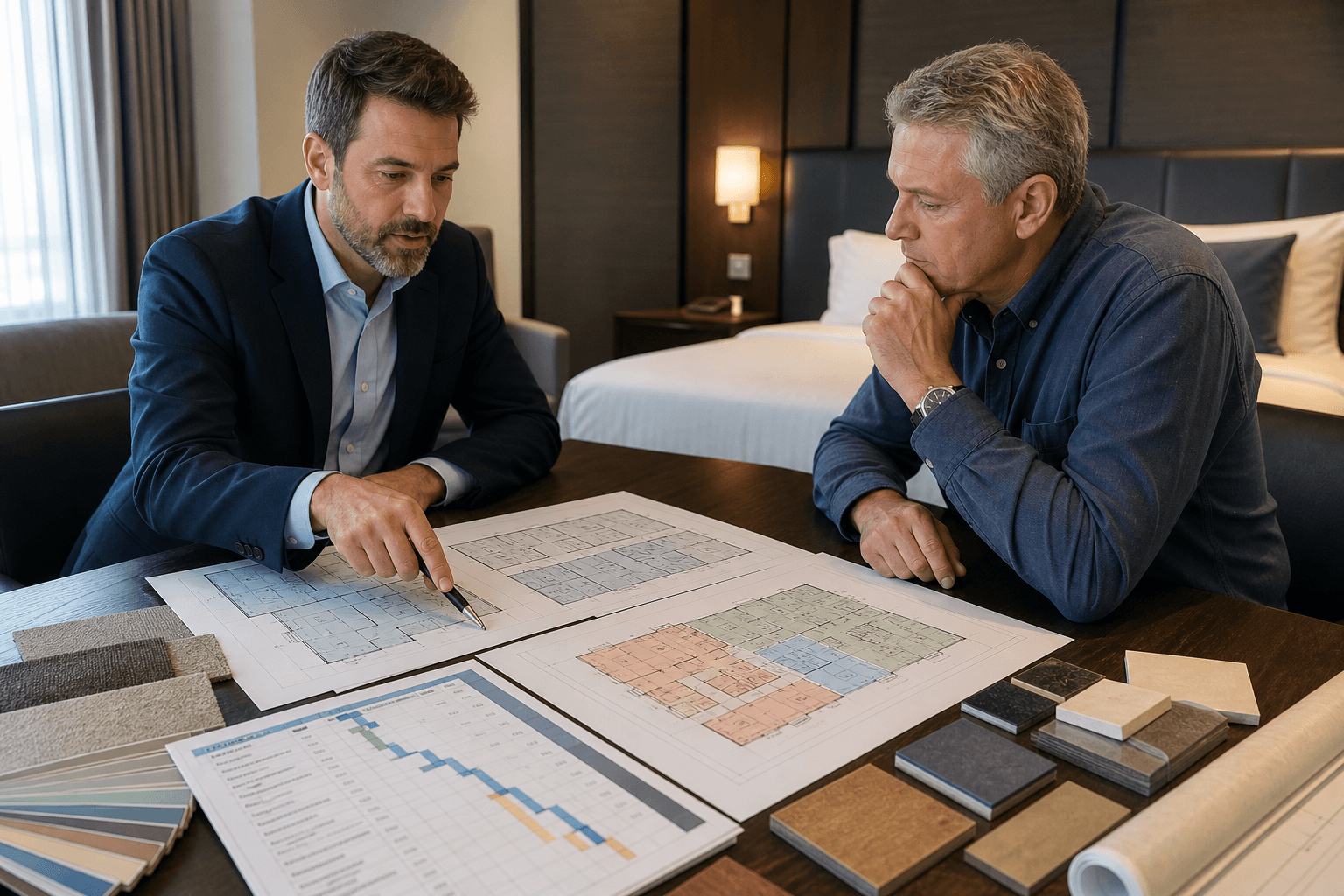
A fast-track hotel renovation is not simply a conventional project performed more quickly. It is a controlled approach that brings scope definition, procurement, phasing, trade coordination, and hotel operations together before work begins. The aim is to reduce avoidable delays and disruption without removing the quality and safety checks an operating property requires.
The strongest plans define the work early, coordinate materials before they are needed, separate construction from guest and staff movement, and assign clear responsibility for decisions. An operating hotel also requires planning around guests, staff, deliveries, daily operations, cleanliness, safety, and defined work zones.
Step 1: Define the Renovation Scope Before Chasing Speed
Start with a written scope. Identify whether the project includes guestrooms, bathrooms, corridors, a lobby, restaurants, amenities, back-of-house areas, building systems, or exterior elements. A hotel room redesign may require a different operating plan from a lobby renovation or a broader property repositioning project.
Separate confirmed work from optional upgrades. For each area, document the finish standard, functional requirements, demolition limits, replacement items, and expected handoff condition. Also identify decisions that could expand scope, such as concealed conditions, layout changes, or requests to upgrade adjacent areas after demolition begins.
JR07 Development lists hospitality renovation, motel rebuilds and restoration, lobby and room redesign, and fast-track delivery among its hotel and commercial capabilities. Review its services against the project’s intended scope.
Stop point: Do not mobilize with an unstable scope
Before mobilization, confirm the areas included and excluded, finish standards, operating constraints, restricted work periods, approval authority, contractor responsibilities, and owner responsibilities. If these points remain unresolved, working faster can magnify confusion rather than save time.
Step 2: Map How the Operating Hotel Will Function During Work

An occupied hotel is both a construction site and a functioning business. Build an operating plan showing how guests, staff, contractors, deliveries, waste removal, and emergency access will move through the property.
Review arrival and departure routes, elevators, service corridors, loading areas, housekeeping access, staff entrances, storage, and locations where noise or dust could affect operations. Define work zones with appropriate separation from occupied areas. Address daily cleanup, material handling, signage, lighting, and communication with hotel staff.
Renovating an active property requires coordination around guests, staff, deliveries, daily operations, and work zones. Cleanliness, safety, and limited disruption should be planned rather than left to individual trades.
Step 3: Build a Phased Work Plan Around Guest and Staff Movement
Divide the work into manageable phases. Depending on the property, phases may be organized by room group, floor, wing, lobby area, public space, restaurant, or back-of-house zone. The right structure depends on layout, occupancy, access routes, staffing, materials, and project scope.
For each phase, define the construction boundary, operational boundary, quality boundary, and handoff boundary. Phased execution can separate construction from hotel operations, but it does not automatically eliminate disruption. Account for shared elevators, deliveries, noise, cleaning, and incomplete work affecting adjacent areas.
Stop point: Confirm each work zone before the next phase
Do not begin the next phase solely because a calendar date has arrived. First confirm that the current area has been inspected, cleaned, secured, and released according to the agreed handoff process. Check barriers, signage, deficiencies, next-phase materials, and staff communication. If access, safety, cleanliness, or completed work is not ready, pause the transition.
Step 4: Coordinate Design, Approvals, and Materials Early
Fast-track delivery becomes difficult when design decisions and procurement are treated as separate tasks. Confirm room layouts, finishes, fixtures, casegoods, hardware, lighting, signage, and other project-specific components early enough for the construction sequence to reflect their availability.
Hospitality contractors commonly coordinate preconstruction, model-room development, material selection, sourcing, construction, interior finishes, and FF&E installation. Ask which materials are confirmed, which are subject to substitution, where they will be stored, and what happens if an item becomes unavailable.
Stop point: Release procurement only after critical choices are confirmed
- Approved materials, finishes, fixtures, and equipment.
- Quantities and installation locations.
- Approved alternates and substitution authority.
- Delivery access, receiving, storage, and protection requirements.
- Responsibility for purchasing, inspection, tracking, and shortage escalation.
Prefabrication and just-in-time staging may support schedule control in appropriate projects, but they should be evaluated against the property’s access, storage, installation, and quality requirements.
Step 5: Assign One Clear Owner for Coordination
Accelerated work needs a clear communication structure. Assign responsibility for coordinating the owner, hotel operator, designer, trades, suppliers, and approval participants. Establish one channel for decisions, a method for recording changes, and response deadlines that match the construction sequence.
JR07 Development states that it assigns a dedicated project manager to every project and offers transparent pricing with no hidden fees and a free quote. Before work starts, agree on progress reviews, change authority, escalation procedures, and updates about access, noise, deliveries, and handoffs.
Step 6: Protect Quality, Safety, and the Guest Experience During Execution
Speed should change the coordination model, not remove quality controls. Maintain daily procedures for safe separation, housekeeping, material protection, waste removal, and communication with the operating team. Control construction areas so guests and unauthorized staff cannot enter them while required routes remain usable.
Use inspection points for demolition, rough work, concealed conditions, installation, finishes, and final cleaning. Record deficiencies when found and assign an owner and resolution path. An accelerated project still needs time for corrections, testing, cleaning, and handoff.
Step 7: Review Every Phase Before Moving Forward
- Inspect completed work. Compare it with the approved scope, drawings, finish standards, and quality requirements.
- Record deficiencies. Assign responsibility and a resolution path.
- Confirm next-phase materials. Verify quantity, condition, delivery status, storage, and substitutions.
- Recheck access and staffing. Confirm the next zone can be isolated and supported.
- Update hotel operations. Communicate route changes, availability, noise, cleaning, and handoff plans.
- Document approval. Record who accepted the phase and any conditions before proceeding.
How to Evaluate a Hotel Renovation Contractor
Look beyond a promise to work quickly. Ask whether the contractor can explain operating-hotel coordination and provide:
- Relevant hospitality renovation experience.
- Experience with guestrooms, bathrooms, lobbies, public spaces, back-of-house areas, or commercial build-outs.
- A dedicated project manager and clear communication process.
- Procurement procedures for approvals, substitutions, deliveries, storage, and shortages.
- Transparent inclusions, exclusions, allowances, changes, and payment responsibilities.
- End-to-end coordination from demolition through finish work.
- Verifiable licensing and insurance.
JR07 Development is a licensed, bonded, and insured general contractor based in Los Angeles. The company reports more than 25 years of experience and more than 500 completed residential, commercial, and hospitality projects. It serves Los Angeles, Orange, San Diego, and Riverside counties. Review its company background and hotel and commercial renovation services against the property’s needs.
When Should You Proceed, and When Should You Pause?
Proceed toward mobilization when the team can consistently answer what is being renovated, how guests and staff will move, which materials are approved and available, who makes decisions, how safety and cleanliness will be protected, and what must be inspected before each phase is released.
Pause when a critical finish is undecided, a work zone cannot be safely separated, procurement ownership is unclear, an operating constraint has not been addressed, or the next phase depends on incomplete work. A pause is a control measure, not a failure of fast-track delivery.
Conclusion: Accelerate Through Preparation, Not Guesswork
A fast-track hotel renovation stays controllable when the team defines scope before mobilization, maps the operating property, sequences work into practical phases, confirms materials early, assigns accountability, and reviews every handoff. The central question is not whether a contractor promises speed, but whether the project has enough information and safeguards to move quickly without losing control of quality or hotel operations.
Prepare a scope summary, operating-constraints checklist, preliminary phasing plan, finish schedule, and list of decision owners before comparing proposals.
JR07 Development is a licensed, bonded, and insured general contractor serving Southern California, including Los Angeles, Orange, San Diego, and Riverside counties. The company provides hotel and commercial renovation services, assigns a dedicated project manager to every project, and offers a free quote through its contact page.