
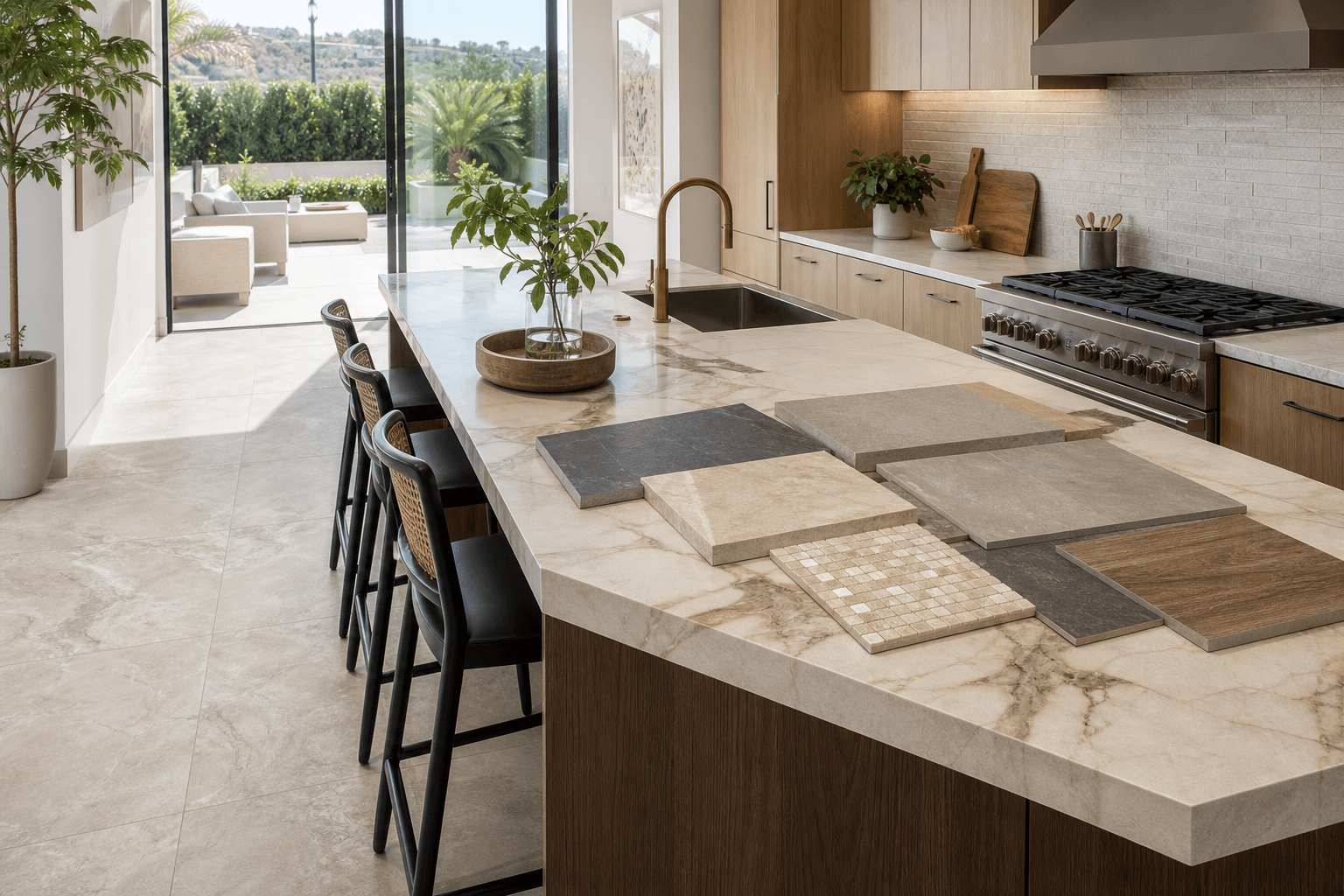
Premium tile selection should begin with the room, not the showroom. A beautiful tile can be the wrong choice if its finish, format, grout layout, or installation requirements do not suit the space. Start by assessing moisture, traffic, cleaning expectations, lighting, and nearby materials. Then compare tile material, size, finish, color, pattern, and installation scope.
Quick summary

Start With the Room Before Choosing the Tile
List the surfaces you are tiling and the conditions each one will face. A kitchen backsplash deals mainly with splashes, grease, heat, outlets, and frequent wiping. A kitchen floor must also work with foot traffic, furniture, cleaning routines, and transitions. A shower introduces persistent moisture, corners, niches, drainage, and waterproofing coordination.
Assess visual scale as well. Large rooms may support larger tiles with fewer visible joints, while compact rooms can benefit from formats that accommodate corners and fixture changes without excessive cutting. Small tiles add rhythm and detail, but they also introduce more grout lines. Neither approach is automatically more premium.
Bring cabinet, countertop, paint, and hardware samples into the actual room. View tile in daylight and under the planned artificial lighting. A sample that looks warm in a showroom may appear cooler, darker, or more reflective at home.
Compare Premium Tile Materials by Practical Tradeoff

“Premium” describes overall fit, finish, design, and installation quality more reliably than it describes one material. Use this comparison to create a shortlist, then confirm the specific product's care instructions and installation requirements.
| Material | Potential strengths | Questions to resolve |
|---|---|---|
| Porcelain | Broad design options and applications ranging from floors to walls. | Is the finish appropriate, and can the installer handle the format and cuts? |
| Ceramic | Many colors, shapes, and decorative styles, especially for walls and backsplashes. | Is it intended for the surface, and how will edges, corners, and grout be finished? |
| Natural stone | Distinct variation and a material-led appearance. | What sealing, cleaning, color variation, and ongoing care are required? |
| Glass | Light-reflective, crisp, decorative effects on suitable walls and backsplashes. | How will translucency, adhesive, cuts, outlets, and edges affect the installation? |
| Slab-like surfaces | A broad visual field with fewer apparent joints. | Can the space, access route, substrate, handling plan, and installer support it? |
JR07 Development describes its remodeling work as using premium materials and proven techniques. For a homeowner, that should lead to a specific conversation about the proposed product, preparation, installation method, care requirements, and complete project scope.
Choose Tile by Kitchen and Bathroom Surface
Do not select one tile for every surface simply because it looks attractive on a sample board. Coordinating materials can create continuity, but each application still needs its own performance and layout review.
Kitchen backsplash tile
A backsplash can add character without covering the room in a demanding pattern. Consider its relationship to cabinet doors, countertops, appliances, outlets, open shelving, and installation height.
If the countertop has strong veining, a quieter backsplash may create balance. If cabinets and counters are restrained, a patterned, textured, or hand-finished-looking tile may provide the focal point. Ask how grout color will change the pattern and how easily the surface can be wiped behind the cooktop and sink.
JR07's kitchen remodeling services include cabinetry and countertop work, flooring and backsplash installation, lighting and electrical upgrades, plumbing, and layout redesign. Coordinating these elements early helps prevent a backsplash decision from conflicting with outlet placement, cabinet height, or countertop edges.
Kitchen floor tile
Prioritize cleaning routines, traffic, furniture placement, visual continuity, and transitions to adjoining flooring. A heavily textured surface or layout with many grout joints may create a different maintenance experience from a smoother, more continuous design.
Large-format tile can make a floor feel calmer by reducing visible joints, but it requires careful layout, handling, cutting, and substrate preparation. Standard formats may be easier to coordinate around irregular walls and cabinets. Request a layout showing grout lines, cabinet boundaries, doorways, and transitions before installation.
Bathroom floor tile
Consider the vanity, toilet, tub, shower entry, and door swing together. The format should work with the room's geometry and planned drainage, while the surface should match expectations for cleaning and underfoot feel.
A smaller format can support detailed layouts and changes in direction, but it increases grout maintenance. A larger format can look uncluttered while requiring more precise planning around fixtures. Coordinate the floor with shower and wall surfaces rather than treating it as an isolated purchase.
Shower walls and floors
Wet-area tile is part of a water-management assembly, not the waterproofing itself. Before finalizing the tile, confirm the substrate, waterproofing system, corners, niches, bench details, drain location, slope, grout, sealant, and sequencing with the installer.
Large-format wall tile can reduce visual interruptions, but the layout must account for plumbing penetrations, niches, corners, and available surface size. Mosaic tile may provide flexibility on a shower floor, but it creates more grout to clean. The right choice depends on the complete assembly and installation plan.
Before approving a wet-area finish, account for professional tile work and waterproofing so the finished surface is coordinated with underlying preparation and bathroom scope. The California Contractors State License Board identifies ceramic and mosaic tile installation within the stated scope of the C-54 classification, so clarify who is responsible for the work and how it will be performed.
Bathroom feature walls and whole-home continuity
A feature wall works best when its boundaries are intentional. Decide whether the pattern should stop at the vanity, continue into a shower, wrap a niche, or meet another material at a clean edge. A dramatic stone-look surface may need simpler flooring and hardware around it.
For whole-home continuity, repeat a color family, grout tone, finish, or general format rather than using the same tile everywhere. The goal is a connected sequence between rooms, not a uniform surface that ignores different kitchen, bathroom, entry, and living-area needs.
Balance Tile Format, Finish, Pattern, and Grout
Format affects appearance and installation. Large-format tile emphasizes broad planes and reduces joint visibility, but it calls for careful measurements, a suitable substrate, and a layout that avoids awkward narrow cuts. Standard formats can be easier to center around fixtures. Mosaics provide detail and flexibility, but additional grout lines affect cleaning and visual texture.
Finish changes the experience of a room. Matte surfaces create a softer appearance, while polished surfaces reflect more light and may show marks or water spots more readily. Textured tile adds depth, but ask whether its surface will be easy to clean in its planned location.
Review patterned tile as a complete layout, not just a single sample. Confirm orientation, repeat, border treatment, corners, cuts, and how the design meets cabinets or fixtures. Discuss waste allowance before purchase. The appropriate amount depends on material, format, pattern, room shape, and layout.
Premium Tile Selection Decision Table
| Priority | Start by considering | Verify before approving |
|---|---|---|
| Fewer visible grout lines | Larger format or slab-like visual | Substrate, handling, access, cuts, and installer experience |
| Decorative focal point | Patterned, textured, stone, or glass wall tile | Grout color, repeat, edges, cleaning, and surrounding materials |
| Simple cleaning routine | Practical finish and manageable joints | Care instructions, grout strategy, texture, and splash exposure |
| Flexible shower-floor layout | A format suited to drainage and slope | Waterproofing, substrate, drainage, grout, and slip considerations |
| Continuity across rooms | Shared palette, finish, or design language | Transitions, lighting, room conditions, and availability |
Tile Brief and Contractor Handoff Checklist
Give the contractor a written tile brief before materials are ordered. Include:
- Room names, surfaces, dimensions, and intended use.
- Product names, sizes, finishes, colors, patterns, and approved samples.
- Photos of the room and samples viewed in its actual lighting.
- Grout color, joint preference, trim, edge treatment, corners, niches, and transitions.
- Cabinet, countertop, plumbing, appliance, fixture, and drain relationships.
- Maintenance expectations, including sealing or special cleaning.
- Substrate preparation, waterproofing, demolition, leveling, and installation responsibilities.
- Material availability, delivery timing, inspection, and waste allowance.
- What the quoted price includes, excludes, and how changes will be approved.
Ask for a scope distinguishing tile materials from preparation and labor. It should clarify whether demolition, disposal, substrate repairs, waterproofing, layout, trim, grout, sealant, and final cleaning are included. JR07 describes transparent pricing and dedicated project management as part of its service approach, which can help coordinate several trades and finish decisions.
What to Verify With a California Contractor
Verify the contractor's license through the California Contractors State License Board rather than relying only on a number printed on a bid. The CSLB advises consumers to confirm that a license is valid. Review its contractor verification guidance during your selection process.
Ask whether the scope covers tile installation, waterproofing, related plumbing or electrical changes, and project coordination. If a specialist performs part of the work, clarify who contracts with that specialist and who remains responsible for the completed scope.
For California home improvement projects exceeding $500 in combined labor and materials, the CSLB states that a written contract is required. The contract should describe the work, materials, price, payment terms, and responsibilities. Changes should also be documented in writing, as explained in the CSLB's written-contract requirements.
Frequently Asked Questions
Is porcelain or natural stone better for a premium bathroom?
Neither is universally better. Porcelain may suit homeowners seeking coordinated designs and a defined care routine, while natural stone offers variation and material character. Compare the specific product's maintenance, sealing, finish, availability, and installation requirements.
What tile format is easiest to maintain in a shower?
Maintenance depends on the surface, grout amount, ventilation, cleaning routine, and installation quality. Larger wall formats can reduce visible joints, while smaller formats may fit the shower floor and drainage layout more effectively.
Should backsplash tile be chosen before countertops and cabinets?
Coordinate all three decisions together. Cabinet color, countertop movement, outlet locations, and backsplash height affect one another. Compare physical samples in the same lighting before approving the combination.
How much tile waste should be discussed before ordering?
There is no single allowance for every project. Room geometry, tile size, pattern repeat, directional layouts, defects, and future repairs all matter. Have the installer calculate the requirement from the final layout.
Does shower tile selection need to be finalized before waterproofing begins?
The waterproofing assembly should be planned with the finished layout in mind, especially around niches, benches, corners, penetrations, and drains. Confirm the intended format, thickness, layout, and detailing before wet-area work progresses.
What should a California remodeling contract say about tile installation?
It should identify rooms and surfaces, materials, preparation, waterproofing, labor, grout, trim, exclusions, price, payment schedule, and ordering responsibilities. Record changes in writing before work proceeds.
Make the Tile Decision With the Installation Plan in View
The strongest premium tile choice fits the room's moisture, traffic, cleaning, lighting, and layout conditions while supporting the design you want. Narrow the decision in this order: application, material, format, finish, color, pattern, grout, and installation scope.
Before ordering, review samples in the space, document transitions and edge details, confirm care requirements, and ask how substrate preparation and waterproofing affect the plan. A tile decision is not complete until the contractor's written scope explains how the material will be installed.
Homeowners planning kitchen or bathroom remodeling across Southern California can discuss tile, backsplash, flooring, waterproofing, and related coordination with JR07 Development, a licensed, bonded, and insured general contractor serving the region.