
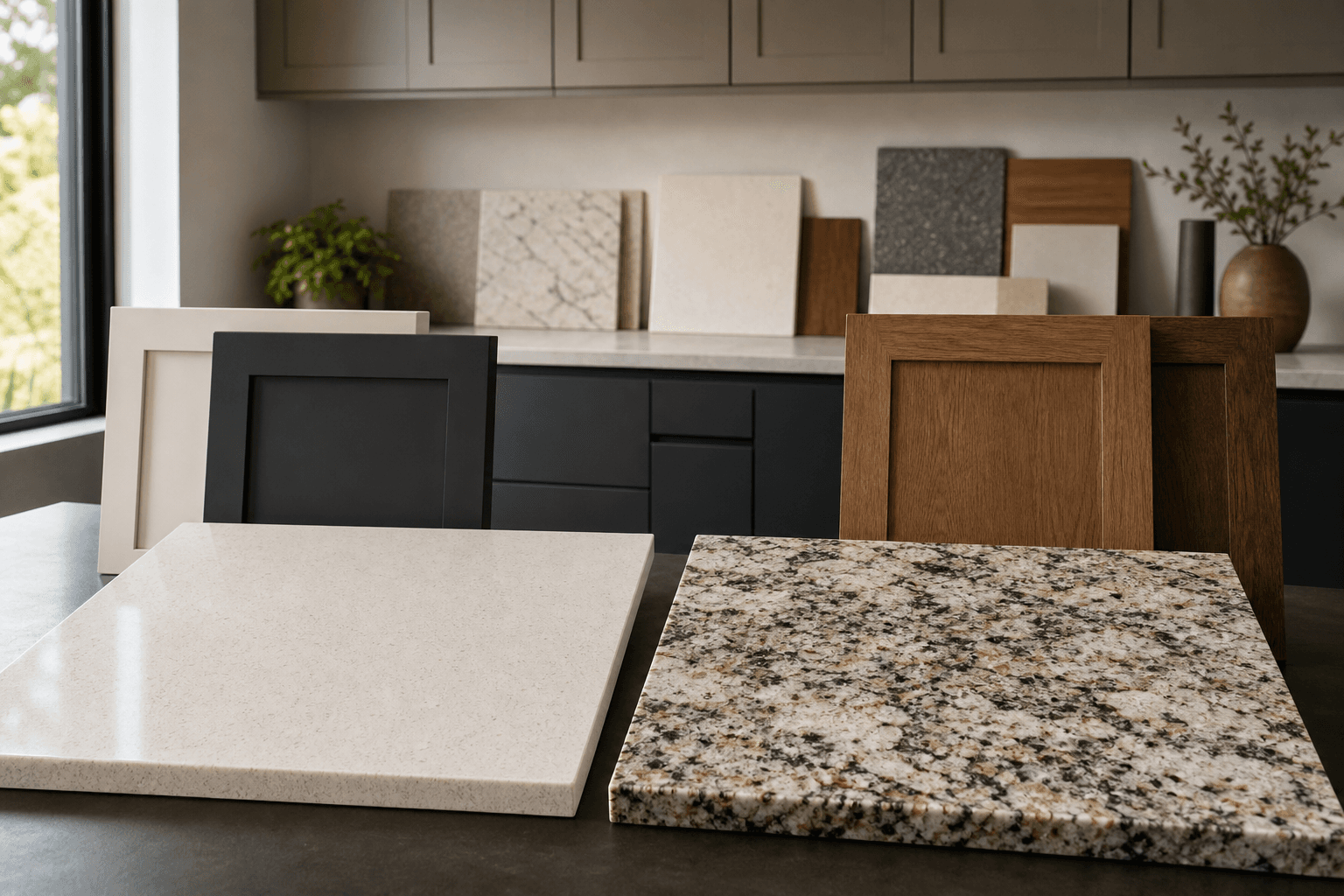
Quartz vs granite countertops come down to how you cook, how much maintenance you accept, and the complete installation scope. Quartz suits consistent appearance and low routine maintenance, while granite offers natural variation and stronger tolerance for direct heat.
Quartz and Granite Are Different Materials, Not Just Different Colors
Quartz countertops are engineered surfaces made from ground natural quartz combined with resin and pigments. The manufacturing process creates a more consistent color and pattern, although individual slabs still vary by collection and design. Source: Engineered Stone Countertop Fabrication Health and Safety Hazard Alert.
Granite is natural stone quarried in blocks and cut into slabs. Each slab has its own mineral movement, veining, flecks, and color variation. That individuality can become the focal point of an island, but the sample you approve may not show every detail of the full slab.
The difference matters beyond appearance. Quartz generally offers more predictable pattern continuity and does not require routine sealing. Granite provides a natural surface with variation that can suit wood cabinetry, textured tile, and kitchens designed around an organic material palette.
If you are also considering quartzite, marble, or other surfaces, use this stone countertop selection guide to compare the wider group before narrowing the decision to quartz or granite.
Choose by How You Use the Kitchen
For durability and cost, choose the surface that solves your daily priorities instead of choosing by reputation alone. Quartz often fits a busy, low-maintenance kitchen, while granite can be the stronger design choice for homeowners who want natural variation and frequently use high heat. Related reading: Best Quartz Bangers: How to Choose the Right Design for Your Dab Rig.
| Decision factor | Quartz | Granite |
|---|---|---|
| Appearance | More consistent color and pattern; many manufactured looks are available. | Natural movement and variation; every slab has distinct character. |
| Routine maintenance | Low maintenance and does not normally require sealing. | Simple daily care, plus sealing based on the stone’s porosity and sealer used. |
| Stains | Resists many everyday spills, but standing liquids and harsh products should still be avoided. | Can resist stains when properly sealed and cared for, but porous areas need more attention. |
| Scratches | Resistant to normal kitchen wear but not scratch-proof. | Durable in everyday use but can also be scratched by abrasive materials. |
| Heat | Use a trivet for hot pans and heat-producing appliances. | Generally more tolerant of direct heat, but thermal shock and concentrated heat can still cause damage. |
| Repairs | Small chips may be repairable, but a repair can remain visible depending on location and pattern. | Chips and cracks may be repairable, with results depending on the damage, stone pattern, and access. |
For a busy family kitchen
Quartz is often practical if children are spilling drinks, several people are preparing food, and you want to wipe the surface without managing a sealing routine. It still needs reasonable care around sharp impacts, hot cookware, and abrasive cleaners.
For heavy cooking and frequent hot cookware
Granite deserves serious consideration if you regularly move hot roasting pans, cast-iron cookware, or baking sheets across the kitchen. Even with granite, use sensible heat protection because concentrated heat, thermal shock, or an impact at an edge can cause damage.
For a statement island
Granite can provide a one-of-a-kind centerpiece when the design depends on natural veining and mineral movement. Quartz may suit you better when the island, perimeter counters, and backsplash need a controlled, repeatable visual relationship.
For a low-maintenance rental or frequently used home
Quartz simplifies routine ownership because sealing is not part of normal care. Granite can also perform well, but the owner or property manager must understand the selected stone’s porosity and maintenance requirements.
Heat, Scratches, Stains, and Daily Care
Neither surface is indestructible. Use trivets for hot cookware, cutting boards for knives, mild cleaning products, and prompt cleanup for spills containing oils, pigments, or acidic ingredients.
Can you put a hot pan on quartz?
You should not place a hot pan directly on quartz. Use a trivet because concentrated heat can stress the resin-containing surface and cause discoloration or damage, particularly near seams and edges.
How do you clean granite countertops?
Clean granite with a soft cloth, warm water, and a mild stone-safe cleaner. Wipe spills promptly, especially oil, wine, coffee, and strongly colored foods. Avoid abrasive powders, aggressive acids, and products that can leave a film or weaken the sealer.
Granite sealing has no universal interval. The appropriate schedule depends on the stone’s porosity, the sealer, kitchen use, and whether water or staining begins to penetrate more readily.
Fabrication and Health Considerations in California
Fabrication quality affects both materials. Measurement, templates, cutouts, edge treatment, seam placement, polishing, transportation, and installation must work together. A well-chosen slab can still produce a poor result if the layout or handling plan is vague.
California identifies workers who cut and finish engineered-stone countertops, commonly called quartz, as being at risk of silicosis. California’s respirable crystalline silica requirements include qualifying engineered-stone fabrication activities, and state guidance notes that granite and other natural stones can also contain crystalline silica. These are fabrication safety matters for trained workers and employers, not a reason to cut countertop material in an occupied home. California’s engineered-stone health alert, current silica requirements, and the 2025 workplace air-monitoring guide explain the relevant risks and controls.
For the homeowner, ask who is responsible for templating, fabrication, delivery, cutouts, installation, and damage discovered during handling. This countertop fabrication process explains the decisions connecting measurement to installation.
Compare the Installed Cost, Not a Material-Only Price
There is no reliable universal answer to whether quartz or granite costs less. Prices can overlap because slab selection, layout complexity, fabrication, access, and the surrounding remodel may matter as much as the material category.
Ask each contractor to price the same scope. A useful countertop estimate should identify:
- Material, slab selection, color, finish, thickness, and square footage.
- Expected slab yield, waste, and proposed layout.
- Demolition, removal, disposal, and protection of remaining areas.
- Templating, delivery, handling, and installation.
- Sink, faucet, cooktop, outlet, and other required cutouts.
- Edge profile, corners, build-ups, backsplashes, and waterfall panels.
- Seam locations, pattern matching, and finish work at seams.
- Cabinet adjustments, leveling, support, plumbing disconnection, and reconnection.
- Allowances, exclusions, change-order terms, taxes, and payment stages.
A low material-only figure can become an expensive project after cutouts, demolition, delivery, edge work, and backsplash installation are added. If the countertop is part of a wider remodel, the scope may also include countertop upgrades alongside cabinetry, layout changes, lighting, electrical work, plumbing, backsplash installation, and finish work.
How Layout and Slab Planning Change the Result

Countertop dimensions affect cost and appearance before installation begins. A compact L-shaped kitchen may use material efficiently, while a long island, deep overhang, or waterfall edge can require more slab area, specialized handling, and additional fabrication.
- Long islands: A large island may need a seam if the slab cannot span the required length.
- Corners: Inside corners and angled walls create offcuts and can make pattern direction harder to control.
- Overhangs: Seating overhangs change the load and support discussion. Determine the support method before fabrication.
- Cutouts: Sink and cooktop openings add labor, polishing, and handling requirements.
- Pattern direction: Strong veining may need careful orientation or matching, which can increase waste.
- Waterfall edges: A waterfall panel requires additional pieces and a deliberate seam and pattern plan.
Are granite countertops heavier than quartz?
Granite is not automatically heavier in every real-world installation because weight depends on slab thickness, dimensions, cutouts, and the selected products. Both materials are substantial, so cabinet boxes, substrate, overhangs, access route, and handling should be assessed before installation.
What Must Be Ready Before Templating and Installation

Templating should occur after the conditions controlling countertop dimensions are settled. Use this sequence to reduce avoidable changes:
- Cabinets are installed and level. Countertops cannot be templated accurately against unfinished, moving, or unlevel cabinet work.
- The sink and appliances are selected. Final specifications affect cutout dimensions, clearances, fillers, and support.
- Plumbing and electrical interfaces are coordinated. Faucet locations, cooktops, outlets, and appliance connections should not be left to assumption.
- The access path is measured. Doors, hallways, stairs, elevators, gates, and tight turns may affect slab handling.
- The old counter is removed if included. Confirm who removes it, protects the area, and handles disposal.
- Edges, seams, backsplashes, and overhangs are approved. These decisions influence fabrication and cannot always change after cutting.
- Pattern direction and slab placement are documented. Review the actual slab or layout plan when natural movement or veining matters.
Unresolved sink models, appliance changes, cabinet modifications, hidden wall conditions, and late backsplash decisions commonly lead to revised measurements or change orders. Ask which assumptions the estimate depends on and what happens if those conditions change.
The Short Recommendation: Match the Surface to the Tradeoff
Choose quartz if your priorities are consistent appearance, simple routine care, and a surface that fits a busy kitchen where hot cookware can be managed with trivets. Choose granite if you value natural variation, want a distinctive slab, and accept stone-specific sealing and care.
Either material can work well when the slab, cabinet support, layout, cutouts, seams, and installation plan fit the kitchen. Southern California homeowners can also review local kitchen remodeling services that include countertop installation and layout improvements.
Questions to Settle Before You Approve the Countertop
How are quartz countertops made?
Quartz countertops are manufactured from ground natural quartz combined with resin and pigments, then formed and finished into slabs. The exact formulation varies by manufacturer and product line, so care and heat guidance should match the specific slab.
Does granite need to be sealed, and how often?
Granite may need sealing, but the interval depends on the stone’s porosity, the sealer, kitchen conditions, and manufacturer instructions. Some slabs need more frequent attention than others.
Can quartz or granite countertops be repaired if they chip or crack?
Both can sometimes be repaired, especially after a small edge chip. Cracks, structural movement, heat damage, and damage near a sink or seam require project-specific assessment. Repair visibility depends on color, pattern, location, and workmanship.
What should I ask before approving a countertop quote?
Ask who handles the measure, template, fabrication, delivery, cutouts, seams, installation, protection, plumbing coordination, and damage claims. Also request the slab or pattern plan, edge profile, backsplash scope, exclusions, allowances, and change-order process.
Once you have selected the material and clarified the complete scope, contact JR07 Development about your kitchen remodeling services.